Polyprop Chair – Designed by Robin Day (1962)
There were two different kinds of chairs in my elementary school. One of the two types was made of a thick, heavy plastic-like material and metal; nobody liked these ones because they were uncomfortable and cold. Everyone wanted the other kind because was light and comfortable (plus, you could carve your name into this one and leave your mark on the school forever).
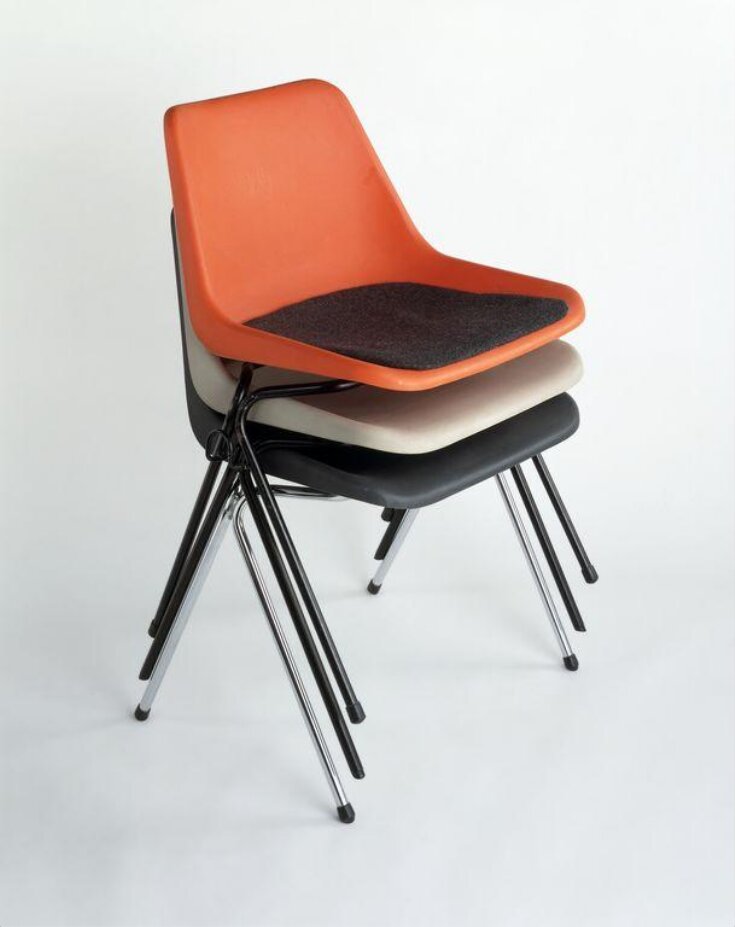 |
| Polyprop Chairs |
At the time I knew nothing about the chair, other than the fact that I liked it more than the other one my school had purchased for some strange reason. I now know that this remarkable piece of furniture was designed by British designer Robin Day in the early 1960s (V&A· Polypropylene chair). Day and his wife were prominent designers in Britain after WWII and played a large role in the design of the Festival of Britain in 1951 (Conekin, 1999). Their work was widely popular exemplified the modernist movement that had started in Europe during the inter-war period (V&A · Lucienne Day – an introduction).
A couple of my blogs so far have focused on objects that have come from the modernist perspective that good design should put function before form, but they have not yet covered the social aspect of modernism. The movement was originally a reaction to the carnage of war that devastated Europe during the first World War; designers wanted to solve issues of inequality and rebuild Europe free from the tradition that had led to this devastation (V&A · what was modernism?). Clearly, they weren’t quite successful as it only took about 20 years for another period of destruction and bombing.
Despite their failure at solving all the problems of the world, they actually had some good ideas about equitability in design. Robin Day agreed and wanted to incorporate the ideas of functionality, efficiency, and equity into his designs. The polyprop chair is undoubtedly one of the best examples of these ideas coming to fruition; it’s light, stackable, strong, comfortable, and cheap (Genius of Design, 2010).
From the materials to the production process the polyprop chair oozes modernism. Day embraced new technology and efficient materials making the chair with metal and polypropylene, a revolutionary new plastic invented by the Italian chemist Giulio Nata (V&A· Polypropylene chair). As for the production process, the chair took less than two minutes to mold and put together. Even better, it costed about a quarter of what traditional wooden chairs did at the time (The Genius of Design, 2010).
The chair was a massive commercial success, but in true modernist fashion, this was not Day’s motivation for his design. Unlike many designers of the post-modernist era that was beginning to emerge with American consumerism, Day was more concerned with creating a functional chair that could be accessed by all than simply designing something that would sell (The Genius of Design, 2010). The polyprop is arguably the best example of modernist design to come out of Britain after World War II; it gets all the ticks for good design from a modernist perspective. Its longevity, widespread use, and lack of alterations over the past 60 years are proof of its greatness. Light, stackable, strong, comfortable, and cheap; what more can you ask for.
References:
Conekin, B. (1999). Moments of modernity: Reconstructing Britain 1945-1964. Rivers Oram Press.
Museum, V. and A. (n.d.). Polypropylene chair (Mark II): Day, Robin: V&A explore the collections. Victoria and Albert Museum: Explore the Collections. Retrieved February 13, 2022, from https://collections.vam.ac.uk/item/O21635/polypropylene-chair-mark-ii-chair-day-robin/
The Genius of Design, Objects of Desire, (2010). BBC2 England, 60 mins. https://learningonscreen.ac.uk/ondemand/index.php/prog/015B94DD?bcast=47729933
V&A · Lucienne Day – an introduction. Victoria and Albert Museum. (n.d.). Retrieved February 13, 2022, from https://www.vam.ac.uk/articles/lucienne-day-an-introduction
V&A · the festival of Britain. Victoria and Albert Museum. (n.d.). Retrieved February 13, 2022, from https://www.vam.ac.uk/articles/the-festival-of-britain
Comments
Post a Comment