Floor Tiles from the House of Commons - Designed by A.W.N. Pugin
When I first entered the Victorian Era rooms at the V&A museum was a bit overwhelmed by wide variety of aesthetics bombarding me as I strolled through. But when I got to the area dedicated to the floors from the House of Commons, I stopped. It said, “PLEASE TOUCH,” so I had to. The best part of museums is touching things. While I was running my hands over the tile, I recognized a familiar name from my class readings; A.W.N. Pugin.
I decided to check out what he had to offer since I appreciated his commitment to designing wallpapers that fit their purpose and place (Wedgewood, 2004). He also happened to be one of the most prominent designers of the design reform movement when Victorian Era designers criticized the British public’s bad taste and offered their own opinions of what good design was. After seeing what the public liked I honestly get it, but even the reformers couldn’t agree on what good design was. For Pugin, it was the Gothic style (Wedgewood, 2004). His exhibit at the Great Exhibition of 1851 (where Britain flexed their design and manufacturing) gave him the chance to share good design with the British public and the world (Wedgewood, 2004).
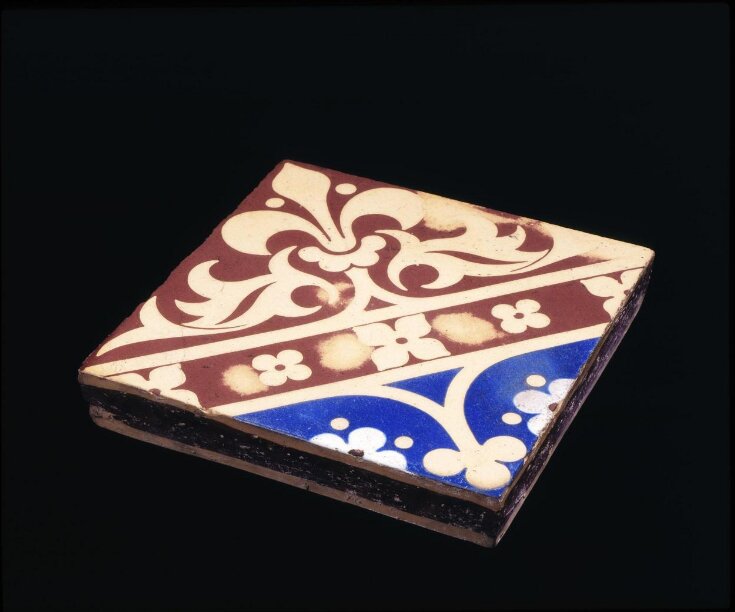
The object in the V&A that led me back to Pugin was a floor tile, designed by Pugin in 1844 for the House of Commons (which would be more accurately described as the House of British Power). It’s pretty impressive that his idea of good design was chosen for this extremely important building. The tile is relatively simple compared to the rest of the exhibit and design enjoyed by the public at the time, which are way more extravagant and ornate. The rich colors and allusions to pointed arches in the design of the tile reveal Pugin’s love of Gothic architecture, and his attempt to revive the style during the Victorian Era to bring what he saw as good taste to the public (RIBA, 2017). The elements of the gothic style displayed on tile also reflect Pugin’s upbringing and background as a Roman Catholic architect (V&A · the gothic style – an introduction).
Gothic architecture is defined in part by the distinctly pointed arches and leaf-forms found in buildings (A LOT of churches) designed in this style; Pugin’s tile pattern has allusions to both these elements. The influence from his love and respect for French artistry and craft is also present through the inclusion of the fleurs-de-lis in the design (Wedgewood, 2004). Pugin believed that good designs for flat surfaces were flat designs that confirm their flatness – a fair point (Wedgewood, 2004). This floor tile is a small but excellent example of what Pugin was fighting for during the design reform movement.
Sadly, Pugin worked too hard; he broke down in 1852 and died relatively early in the Victorian Era (Wedgewood, 2004). His legacy and influence did not die with him as his ideas about the superiority of Gothic design were picked up by other influential designers. One of these chaps was John Ruskin. Ruskin kept his ideas alive, focusing on the artistic freedom and imperfection allowed within the style (Ruskin & Morris, 1851). Pugin’s influence even trickled down through Ruskin to William Morris, the leader of the arts and crafts movement, who embrace ideas of artistic freedom and expression (V&A · introducing William Morris). We often don’t think much about the designs of the surfaces we walk on, but this particular tile offers a lot of insight into A.W.N. Pugin’s philosophy of good design that he fought as a design reformer. less really is more.
References:
Gothic. RIBA. (n.d.). Retrieved February 13, 2022, from https://www.architecture.com/knowledge-and-resources/knowledge-landing-page/gothic
Museum, V. and A. (n.d.). Floor tile: Pugin, augustus Welby Northmore: V&A explore the collections. Victoria and Albert Museum: Explore the Collections. Retrieved February 13, 2022, from https://collections.vam.ac.uk/item/O80580/floor-tile-pugin-augustus-welby/
Ruskin, J., & Morris, W. (1851). The nature of Gothic: A chapter of the Stones of Venice. Pallas Athene Arts.
V&A · introducing William Morris. Victoria and Albert Museum. (n.d.). Retrieved February 13, 2022, from https://www.vam.ac.uk/articles/introducing-william-morris
V&A · the gothic style – an introduction. Victoria and Albert Museum. (n.d.). Retrieved January 25, 2022, from https://www.vam.ac.uk/articles/the-gothic-style-an-introduction
Wedgwood, A. (2004). Pugin, Augustus Welby Northmore (1812–1852), architect, writer, and designer. Oxford Dictionary of National Biography. https://doi.org/10.1093/ref:odnb/22869

Comments
Post a Comment