Penguin Donkey Bookcase - Designed by Egon Riss (1939)
One argument for keeping it classic that I have never considered is about the benefits of filling out a bookcase. Bookcases are underrated but can really make a statement, and it doesn’t get better than the Penguin Donkey Bookcase designed by Egon Riss in 1939 for the Isokon Furniture Company in London.
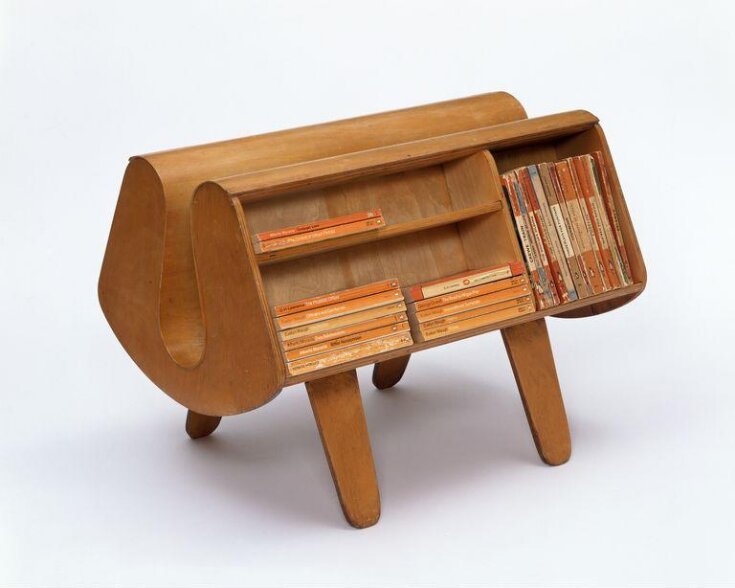 |
| The Original Penguin Donkey Bookcase |
| Jack Pritchard’s Isokon company was dedicated to the new modernist movement in design that rose like a simplistic phoenix from the ashes of World War I (The Genius of Design, 2010). Efficiency and function drove everything they did (The Genius of Design, 2010). Even though form was secondary in the philosophy of the movement, many of the products have a clean beauty in their simplicity. Modernism was all about leaving behind the conspicuous consumption and overly ornate design of the past while focusing on creating products that work well – Riss’s bookcase is a prime example of this vision (V&A · what was modernism?). |
The use of bent plywood was typical in furniture of this era due to its useful and practical combination of lightness and durability – it served its purpose without using up too many resources. Penguin Donkey (half the name comes from a deal with the Penguin book company and the other half is a reference to its donkey-like shape) creating a sleek and elegant bookcase that is able to store both books and magazines (V&A · Penguin Donkey). Names of all of your books can be clearly seen so you can show off what intelligent and intriguing books you’re reading (or at least have), while also showing people that you’re not too lame and read magazines as well.
The bookcase was set to be a smashing hit among consumers, for obvious reasons, but tragically production was cut short due to the relapse back into carnage and violence during World War II (V&A · Penguin Donkey). However, its legacy couldn’t be stopped by the War (V&A · Penguin Donkey). People continued to recognize its beauty of functionality and the product has been reproduced and redesigned a number of times since the original 1939 version (V&A · Penguin Donkey).
Even though the bookcase was reproduced in the years following WWII, it’s almost a perfect metaphor for the early modernist movement; the idea behind it was great, but it was never fully realized in its truest form (V&A · Penguin Donkey). The modernist ideas that came out of the Bauhaus and spread throughout Europe were mainly just that; ideas. Sadly, they often failed to come to life in their fullest form, just like the Penguin Donkey (V&A · what was modernism?). The ideas would take off after WWII, but only a few designers remained true to the ideology as many preferred to use the aesthetic and abandon socialist ideals driving modernism (no surprise many were American) (Hine, 1987). The original Penguin Donkey bookcase is a reminder of the functional foundation where modernism started, and where it will hopefully return.
References:
Hine, T. (1987). Populuxe. Overlook Press.
Kozlowski, M. (2020, November 16). The Sony librie EBR 1000 was the first e-reader with E ink. Reader. Retrieved February 14, 2022, from https://goodereader.com/blog/electronic-readers/the-sony-librie-ebr-1000-was-the-first-e-reader-with-e-ink
Museum, V. and A. (n.d.). Penguin donkey: Riss, Egon: V&A explore the collections. Victoria and Albert Museum: Explore the Collections. Retrieved February 13, 2022, from https://collections.vam.ac.uk/item/O114122/penguin-donkey-bookcase-riss-egon/
The Genius of Design, Designs for Living, 19:00 (2010). BBC2 England, 60 mins. https://learningonscreen.ac.uk/ondemand/index.php/prog/01583F7B?bcast=46586756
V&A · The Sophisticated Modern Home. Victoria and Albert Museum. (n.d.). Retrieved February 13, 2022, from https://www.vam.ac.uk/articles/the-sophisticated-modern-home
V&A · what was modernism? Victoria and Albert Museum. (n.d.). Retrieved February 13, 2022, from https://www.vam.ac.uk/articles/what-was-modernism


Comments
Post a Comment